This morning, in the middle of a rushed breakfast, running late, mind already halfway out the door, I got a bad hiccup. And before I even knew what I was doing, my hand had moved out, reaching for a glass of water I somehow expected to be there.
It wasn’t. Of course it wasn’t. I sat there for a second, hand still hovering in the air and in that strange little gap between expecting and finding nothing, a memory arrived, whole and unbidden, the way they sometimes do – not called for, just suddenly there.
“Khana lagane se pehle paani rakhna, beta.” Before you serve the food, keep the water ready.
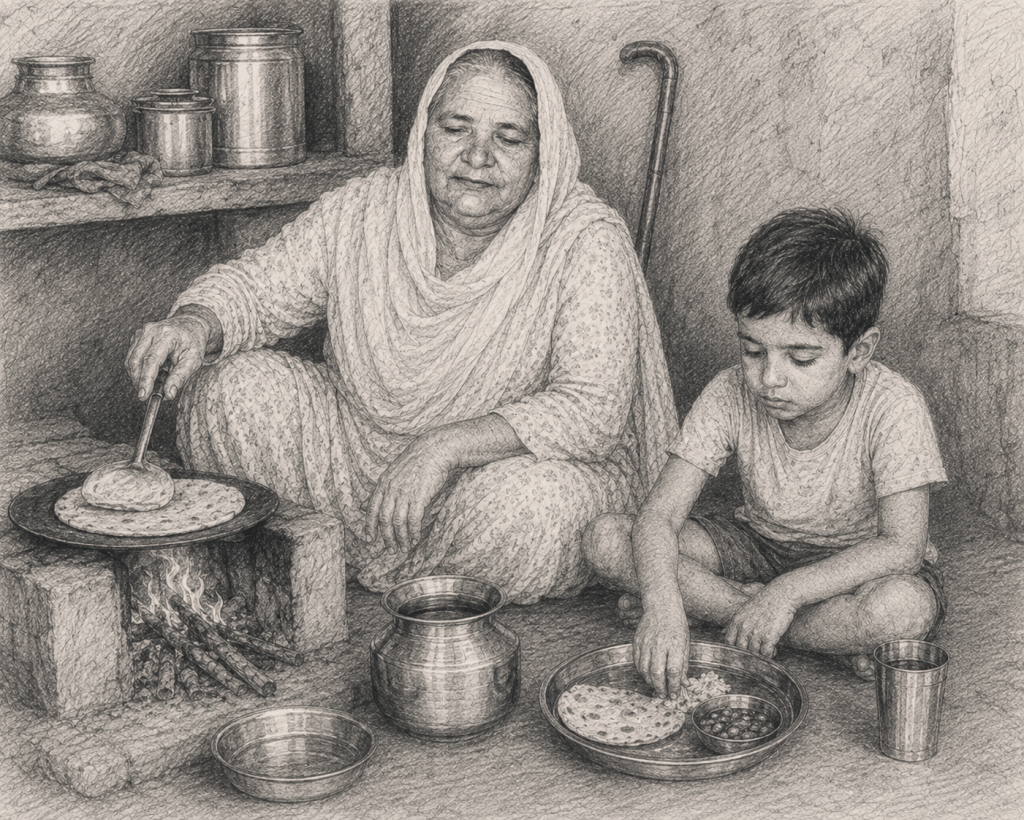
She was my grandmother – Amma, I called her, lovingly, the way most children in the hills do – and she said it every single day. Not for herself alone, but for anyone who sat down to eat in her house. Serving food to yourself, to family, to a guest at the door, it made no difference to her. Water came first, always, before the first roti was even off the tawa. Her hands would be busy with the brass thali, polishing it round and round with a soft cloth kept just for that purpose, the metal turning warm and bright under the hearth-light with each pass of her hand.
I did not know, then, that I was watching the whole of her in that one small, daily act. I know it now. And still, some mornings, over something as small as a hiccup, it comes back to me whole.
I didn’t ask why, back then. You don’t ask Amma why. You just keep the water ready and you grow old enough to understand and by then there is no one left to tell that you finally do.
Not for before the meal only – for in between. For the moment someone’s throat goes dry mid-story, mid-roti, mid-life. She was never one to fuss or fret, but she noticed these things quietly, the way she noticed everything and set it right before you even knew you needed it. I can still hear the sound of that brass glass against the thali – a small, bright, ordinary sound – and I would give anything to hear it just once more instead of only inside my own head.
I was five, maybe six. A village in rural Himachal, hills close enough to lean in and listen, woodsmoke drifting window to window come evening, so that even now, decades and cities away, a certain smell of smoke on a cold morning can bring the whole valley back before I even know why. Winters that bit through thin quilts. Summers when the mustard fields turned the whole valley the colour of butter.
My mother worked at the local post office, a hardworking woman who left early each morning and returned late. My father, a teacher, was posted somewhere in the far-flung mountains of our state, home only rarely, his letters arriving now and then in his careful hand, saved carefully in a tin box that still smelled faintly of ink. My siblings had gone off to my maternal hometown to study, so it was three of us, really – Amma, our dog Tipu and me – musketeers of a sort and I was in her care most of the time.
She never lectured. She just said things – small things, once, never again, because once was enough if you were really listening. I am still listening. I think I will spend the rest of my life listening for her.
“Anna hai, beta.” It is grain.
I’d dropped a roti and almost kicked it aside without thinking, the way children do, careless with things they’ve never had to grow themselves. She didn’t scold me – just those two words, low and certain, spoken so gently they didn’t feel like correction at all. I picked it up, dusted it off with fingers that were, for the first time, trembling. She nodded once. That was the whole lesson. I have kept it longer than I have kept almost anything else she ever gave me.
Our gate never really closed. A hawker passing by. An old face stopping just to say hello. A stranger whose feet had simply brought them there, for no reason at all.
“Andar aa ja, beta. Kuch kha ke ja.” Come in, eat something before you go.
It didn’t matter to her if the fire was almost out, if her knees ached from a day already too long, if the courtyard had gone that deep, quiet blue that settles just before night in the hills. She’d kneel by the hearth anyway, cup her hands and blow, coaxing the dying embers back to orange, then slap the dough flat between her palms and set it on the tawa till it puffed with a soft hiss. The smell of woodsmoke and warm wheat would fill the whole room and somewhere inside me it still does.
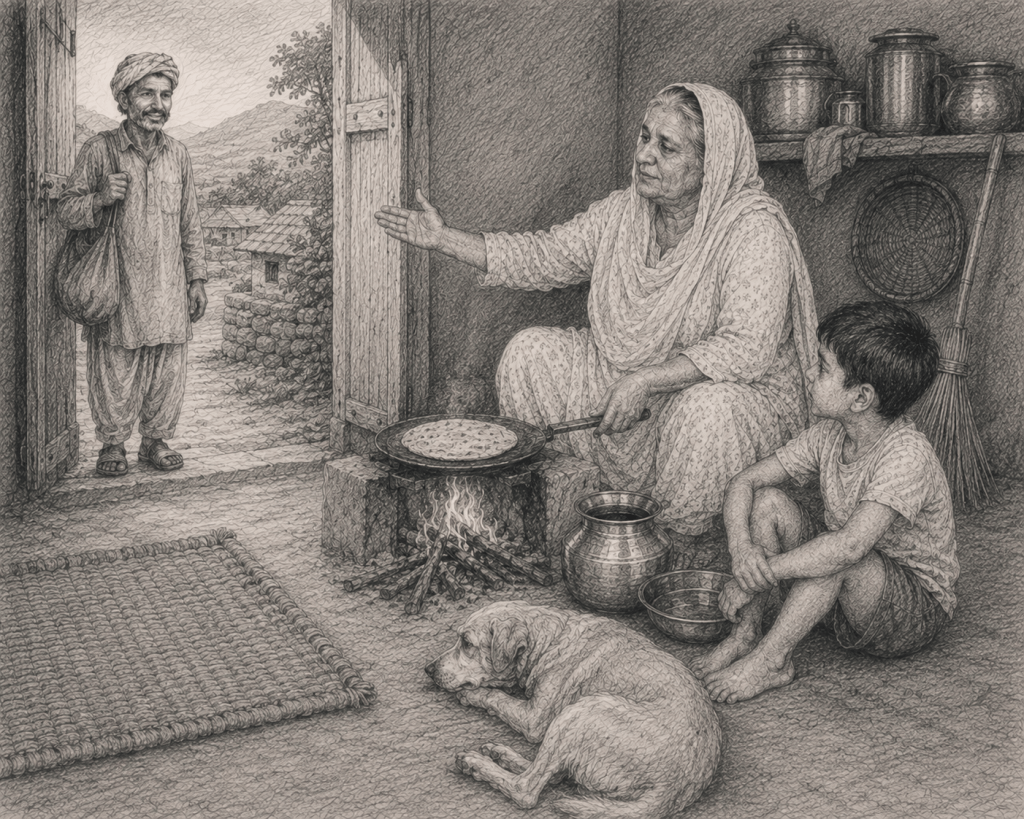
She’d sit them down on the same jute mat we sat on – because in her house, the moment they walked in, they belonged there.
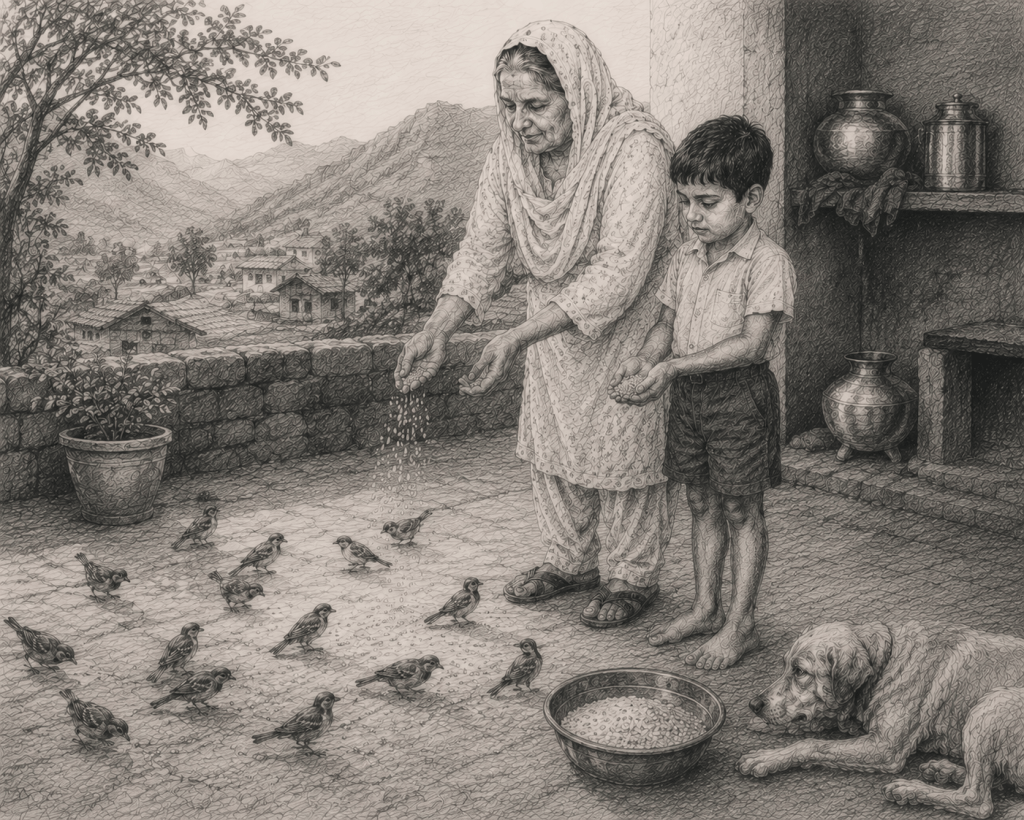
Her kindness was known well beyond our gate. Every morning, before anything else, she’d scatter grain for the birds and trail small mounds of sugar and flour near the anthills in the courtyard, murmuring something to herself as she did it. She made me do it too, pressing the grain into my small palms and standing there until I’d scattered every bit of it. I didn’t understand it then – it seemed like just another chore before breakfast. I understand it now.
I never once saw her let someone leave hungry.
“Bhookha nahi jaane dena kisi ko.” She’d murmur it to herself, almost under her breath, a vow renewed daily, to no one but her own heart. I think I only half-understood, as a boy, that I was watching a kind of prayer.
And then there was the tuladaan. Not cake, not candles – on any birthday in the family, this was how it was marked. It had been her idea from the start, long before I was born – a huge, rickety, beautiful contraption of ropes and a thick wooden beam, two great pans hanging crooked from it, rigged up fresh each time, because she had decided, once, that this was how a birthday in her house would be marked. I remember the rough hemp rope biting into my palms as I climbed in, the pan swaying under my weight, the whole thing creaking like an old door, the sky tilting above me each time it dipped low. Sacks of grain piled onto the other pan, dust rising off them in small golden clouds, until the two sides finally hung level, still, balanced – my whole small self weighed out in wheat, in a custom she alone had thought of and I did not yet know how much love could look like arithmetic.
Then the grain was gone. Given away, to the needy and the poor.
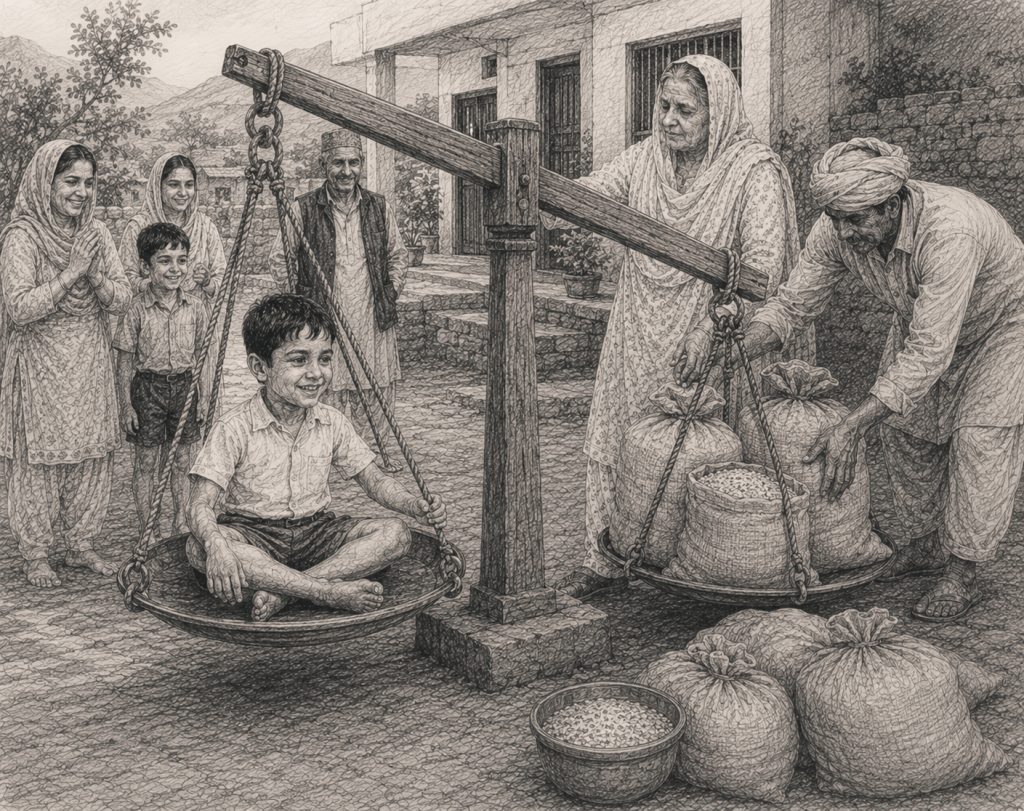
I just liked the swinging. It took me years to understand that my birthday, in her hands, quietly became someone else’s meal. She never once called it kindness. Not once. I did not have the word for it either, not then.
There was a baby eagle once. It fell out of a sky that had, until that moment, seemed too vast and too distant to ever let anything drop. One wing bent the wrong way, feathers dusty and matted with dew, it lay in our courtyard in a small, trembling heap – a whole creature of the air reduced to something no bigger than a closed fist, something broken and briefly forgotten by the very sky it belonged to. I remember standing frozen at a careful distance, small and useless in the face of it. I was scared – scared of the tremor in its wing, of the wildness still flickering in its eye even in surrender, of not knowing whether a thing so small could still die right there in front of me, on our stone floor, in the ordinary light of an ordinary afternoon.
Amma wasn’t scared of anything. She walked up slowly, murmuring something low and wordless and lifted it into her palms as though it weighed nothing at all – as though she had done this a hundred times before and would do it a hundred times again. She built it a small nest from old, soft cloth, tucked into a quiet corner away from Tipu’s curious nose and fed it grain and water, drop by careful drop, morning and evening, for as many days as it took. I watched her check that wing each day with fingers gentler than I had ever seen them.
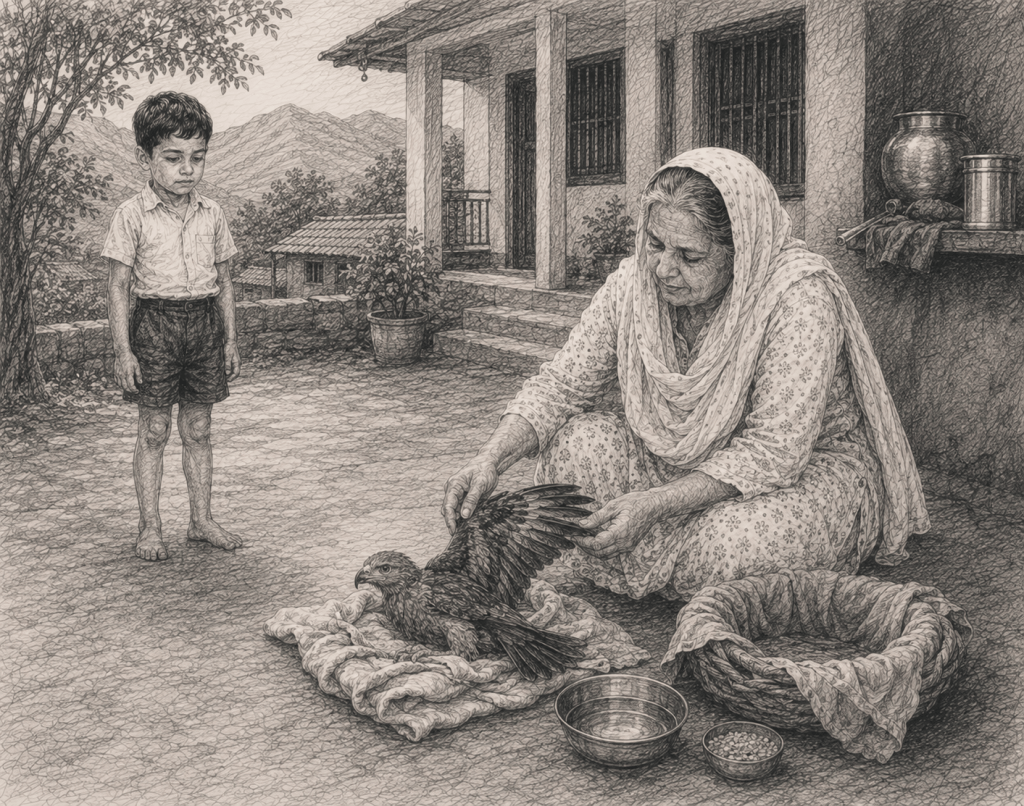
And then one morning it stood a little taller in its nest, flexed its wings once, twice and lifted off her open palms – circling once above the courtyard, as if in farewell, before the sky simply took it back. She never made it a moment. She just did it, the way she did everything and went back to her chores as though saving a life were simply one more small task before lunch.
I did not know, watching her, that I was being shown how to love the world. I only understood it later, long after there was no one left to thank for it.
If I was ever rough with a dog, careless with a bird – “Woh bhi jeev hai, beta.” That too is a living being.
Nothing more needed saying. With her, nothing ever did. Five words and something in me changed shape and never changed back. Tipu, our black Himalayan sheepdog, was never far when she said it – he had a short temper and a fearsome bark for strangers, but around Amma and me, he was the gentlest thing in the house, my constant shadow through every field and orchard those years.
I think about all of it more now than I ever did as a boy standing right there in that courtyard, not knowing I was standing inside something I would spend the rest of my life trying to get back to. Back then it was just Amma being Amma – ordinary, everyday, entirely unremarkable, the way the ground under your feet is unremarkable until it is gone. She never once sat me down to teach me anything. She simply lived and let me watch and somehow that was the whole of the lesson, every time.
I still fill a glass of water before I sit down to eat. Still cannot watch anyone go hungry near me – it aches, physically, somewhere under the ribs. Still pause, just a second, hand suspended in the air, before I could ever be careless with something small and living. And in that pause, every single time, she is there.
This morning, over nothing more than a hiccup at a rushed breakfast table, her hand found mine again, the way it always does when I least expect it – not visible, not real in any way I could point to and yet entirely, unmistakably there. Reaching for a glass that wasn’t there, I found her instead.
Some people leave behind letters, photographs – things you can hold in your hands, turn over in the light, put away in a drawer. Amma left behind habits. Quiet ones. The kind you don’t notice you carry, until one day, over something as small as a hiccup, you realise your hands were never entirely your own.
It was her. It was always her.
 Musings of a Wanderer