There is a dargah in the mountains that I cannot think about without something shifting in my chest — not quite grief, not quite longing, not quite loss. Something nameless that sits just below each of them. Stone steps worn smooth by years of faithful feet. A courtyard swept clean each morning as an act of reverence. Incense and mountain cold, always together, inseparable.
She climbed those steps every Thursday.
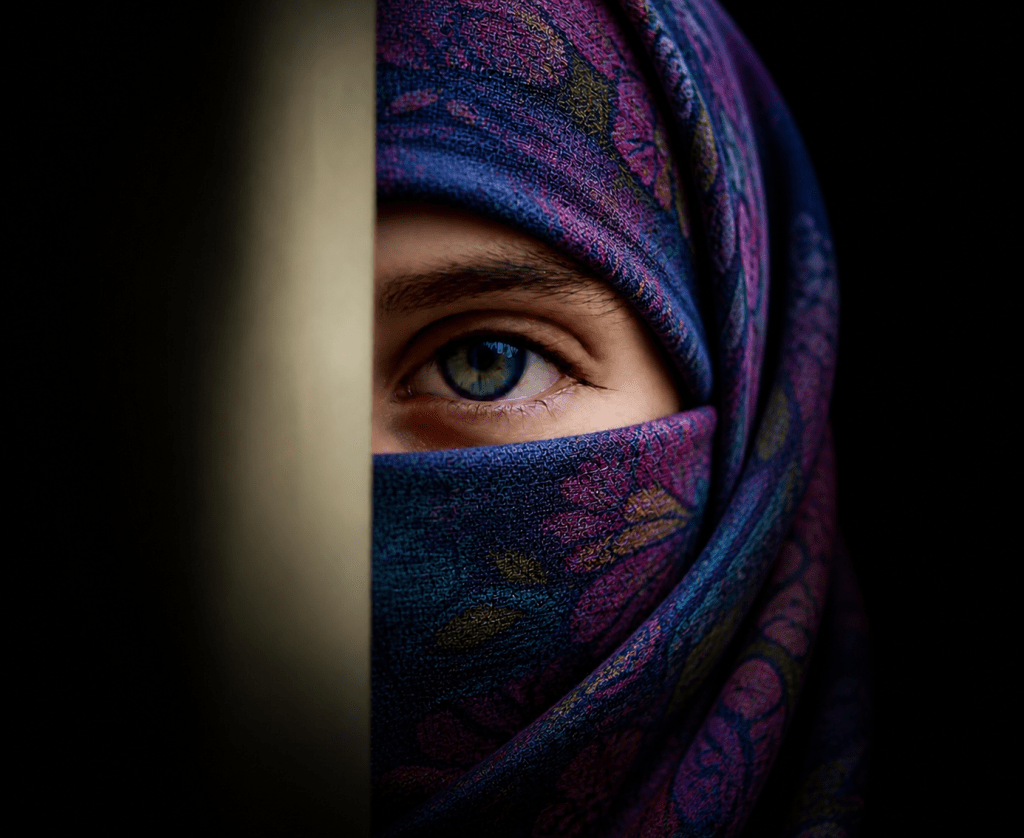
Pink clothes. A juice box held close to her chest. Her father’s hand at her back – not guiding. Just there. She was perhaps eight. And when she saw me standing with my camera, she did not look away. It was the innocence in those grey-green eyes that caught my shutterbug attention immediately – a quality so unguarded, so completely itself, that the camera felt almost like an intrusion.
I raised the camera. She held still – not performing stillness, just inside it, the way some people are before anyone has told them to be otherwise. The shutter closed. I came back the following Thursday.
And the one after that.
Her name was Gulnaz. Her father was a quiet man who earned trust without trying. A porter. Unhurried. He brought her every week and he noted what grew between a man with a camera and his daughter with the ease of someone who had learned long ago how to read what was real. The Thursdays accumulated. Nobody planned them. That was the whole of their value.
I had a daughter of my own. Roughly Gulnaz’s age. Growing up somewhere far and ordinary and safe. I did not think of her consciously every Thursday on those steps. But the part of you that knows, before you know, had already placed them side by side. Same brightness. Same quality of being completely, unself-consciously alive.
I brought her gifts. Eid. Diwali. New Year. Crossing calendars, these were occasions to pamper the child. Not grand gifts. The kind you choose when you actually know someone. She accepted each one the way she accepted everything – directly, those grey-green eyes saying something always slightly beyond the moment, beyond the words, beyond what either of us had the language for.
She was funny. Sharp, the way children are before the world tells them to soften it. She knew she was worth knowing. Not arrogance. Something older than arrogance. Certainty.
The photograph from that first Thursday was eventually exhibited. Galleries. Cities far from that ridge. Printed large. Lit. Titled – The Speaking Eyes. Critics found words for it. Strangers stood before her face in halls she would never walk through and asked me who she was. I told them she was a girl from the mountains. I watched thousands of people stop in front of her, and I knew what they were seeing because I had seen it first, on those steps, on a Thursday morning, with the fragrance of incense still hanging fresh in the air.
When my time there ended, I left with the simple assumption that she would still be there. Why would she not be? She was a child. The Thursdays ahead of her were beyond counting.
I returned a few years later. Went to the village. Asked for her through people who knew both of us. At her maternal home, someone said. I walked the old lanes. Climbed the dargah steps again. Left.
The truth came on the road home. Sideways. Quietly. The way people say things they know will not land well – voice lowered, eyes elsewhere, as if looking away from it might soften it. She had been married off. Nobody told me when. Nobody told me how old she was. I was not supposed to know at all.
I thought of my daughter. I could not finish the thought.
There was no villain. I keep returning to this because it is the thing that will not let me rest. Her father loved her. Truly. The village meant no harm. The decision was made in some ordinary room in ordinary light by people with no doubt at all that they were simply doing what comes next. What has always come next. And that’s the norm; that’s the tradition.
That is how a norm kills. Not with malice. With certainty. A bright girl folded into a life, arranged without her knowledge, without her voice, without even a pause – because in that accounting, there was nothing to pause for.
The photograph still travels. Her face in lit rooms in cities she will never visit. Thousands of strangers still stopping. Still looking into those eyes.
She had speaking eyes. Nobody listened.
She deserved more Thursdays.
 Musings of a Wanderer