For my mother and a world that went quietly
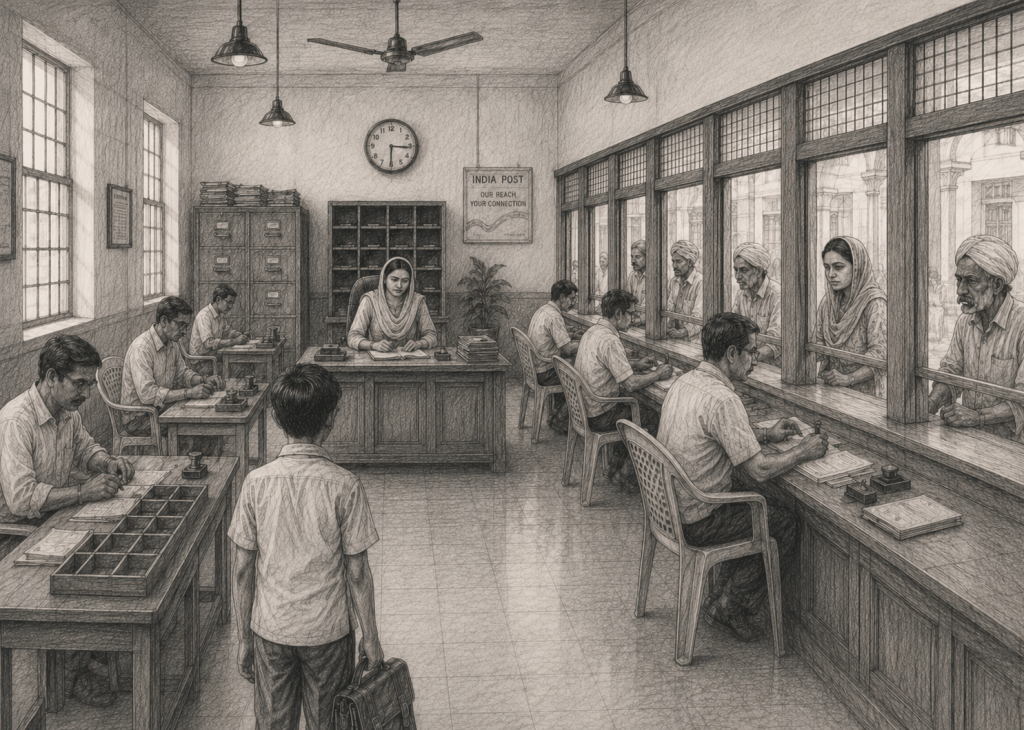
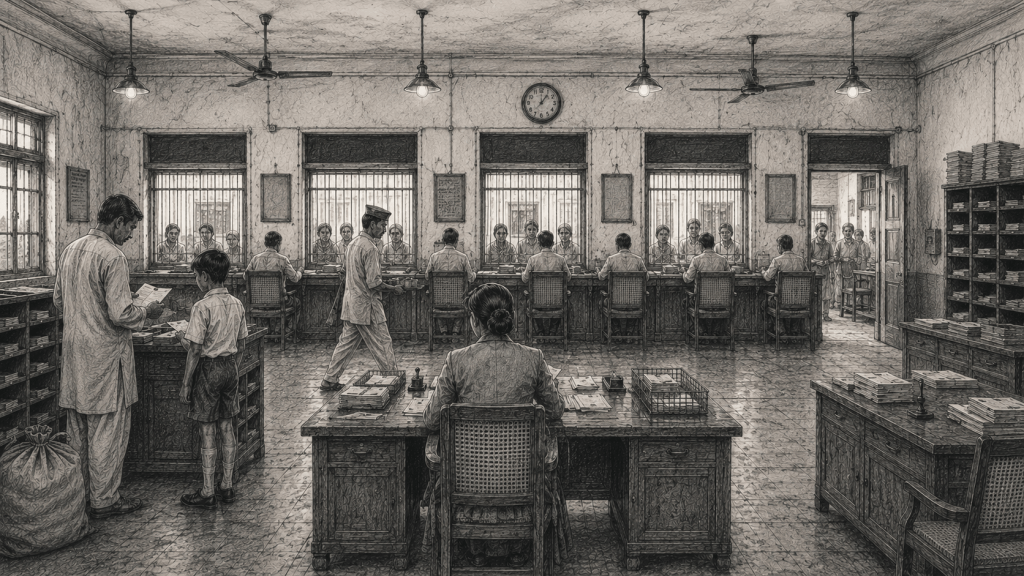
School ended at half past two and I never went straight home. Why would I? Home was ordinary. My mother’s post office was the most interesting place I knew. It was one large hall – government building with high ceilings, iron-grilled windows, counters running across the width of the room – and at the far rear of it all, behind every counter and every working hand and every afternoon transaction, sat my mother. Postmaster. She wore her authority the way the building wore its paint – without fuss, without announcement, as though it had always simply been there. A woman in a government chair at a government desk, files stacked neatly on the table, reading something or signing something or looking up at whoever needed to be looked at. That was enough. The hall organised itself around her. She ran that hall with a quietness that was more effective than any noise. I would push open the door, she would glance up once from her desk and that glance said everything – you are allowed, you are welcome, don’t cause trouble. As I used to drop my bag near her table, the afternoon seemed to open up in front of me like a gift.
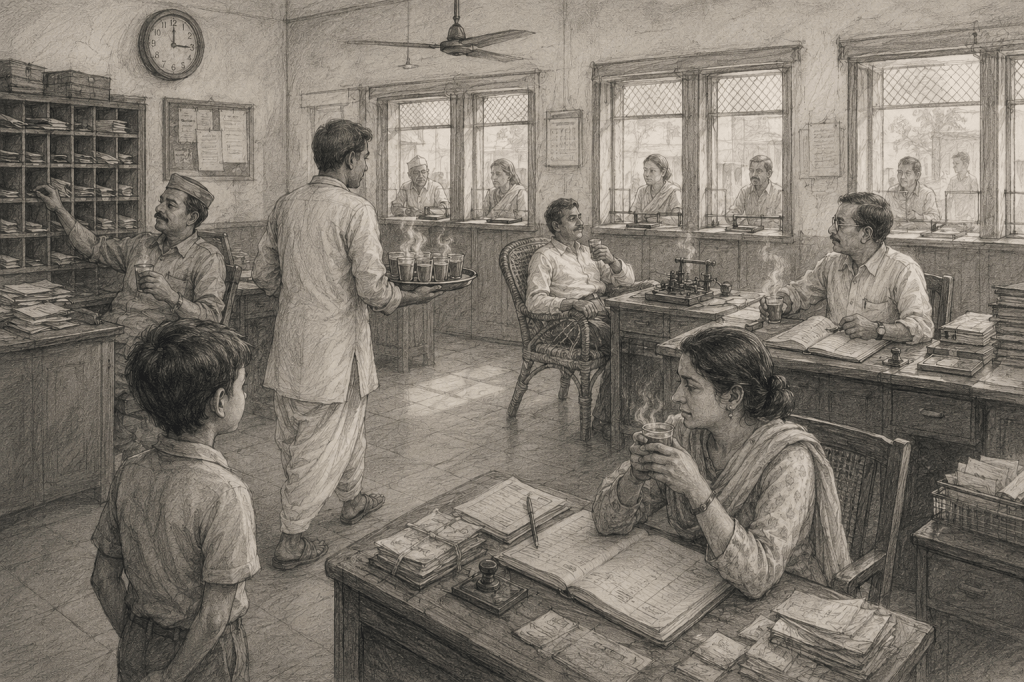
By three o’clock, the peon came around with tea. Tea glasses on a tray, strong and exact, at the same time every day. Every counter got its glass. The postman’s hands stopped moving over the sorting rack, the telegraph man leaned back in his chair, the money order clerk set down his pen. For a few minutes, the whole hall exhaled. I loved that pause. The steam rising from the glasses, the brief conversations, the sense that the afternoon had reached its midpoint and everyone knew it. Then the glasses went back and the hall picked itself up and resumed – noisier somehow, as if the tea had wound everyone a little tighter. I would look across at my mother’s table during that pause. Sometimes she held her glass with both hands and looked at nothing in particular, just resting inside the quiet for a moment. She never looked over at me. She did not need to. I was there, the hall was there, everything was in its place.
The hall had its own population, changing by the hour. A woman in a salwar with a dupatta pulled close, sliding money across the counter for a money order – her lips moving slightly as the clerk filled out the form, checking each detail as if a single wrong letter might mean the money never arrived. An old man waiting for registered post, sitting on the bench along the wall, patient in the way that people are patient when they have been waiting for something for a long time before they even walked in. Village people, people whose sons were at distant places or whose daughters had gone to college in the city – they came to this counter with their needs folded inside them and left a little lighter. The post office was how people reached each other when distance had made reaching difficult. I understood this even then, though I could not have said it in words.
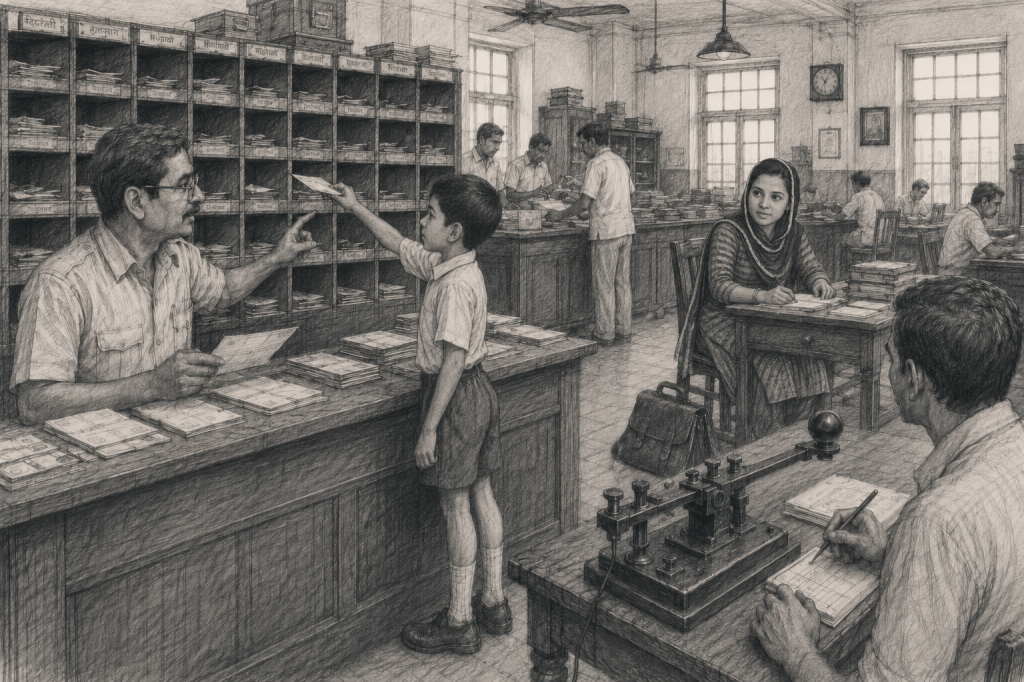
The postman was the first person who let me in. He sat at the long wooden sorting table with the rack of pigeon-holes behind him – small labelled slots, the ink on the labels faded to almost nothing, but he never needed to read them anyway. He would pick up a letter, read the address in one quick sweep and his hand would go to the correct slot before he had even finished. The table came up to my chest. I stood on my toes sometimes to see the rack properly, to match what I was reading on the envelope to the faded labels above the slots. I stood next to him and watched until he noticed me watching and then he handed me a letter without ceremony. I looked at the address. I searched the rack. I found the slot and dropped it in. He handed me another. We kept going – him feeding me letters, me learning the logic of that rack, the way each address was an instruction if you read it precisely enough – until I reached for the wrong slot, same locality but the wrong lane and his hand came quietly across and tapped the right one. No fuss. Just the correction and we continued. Once, from across the hall, I caught my mother watching. She said nothing. She looked back down at her files. But I had seen it – that fraction of a second -and it was enough to make me stand a little straighter at that sorting table. Those afternoons next to him, I felt very useful and very grown up, which is exactly what a boy of that age needs to feel.
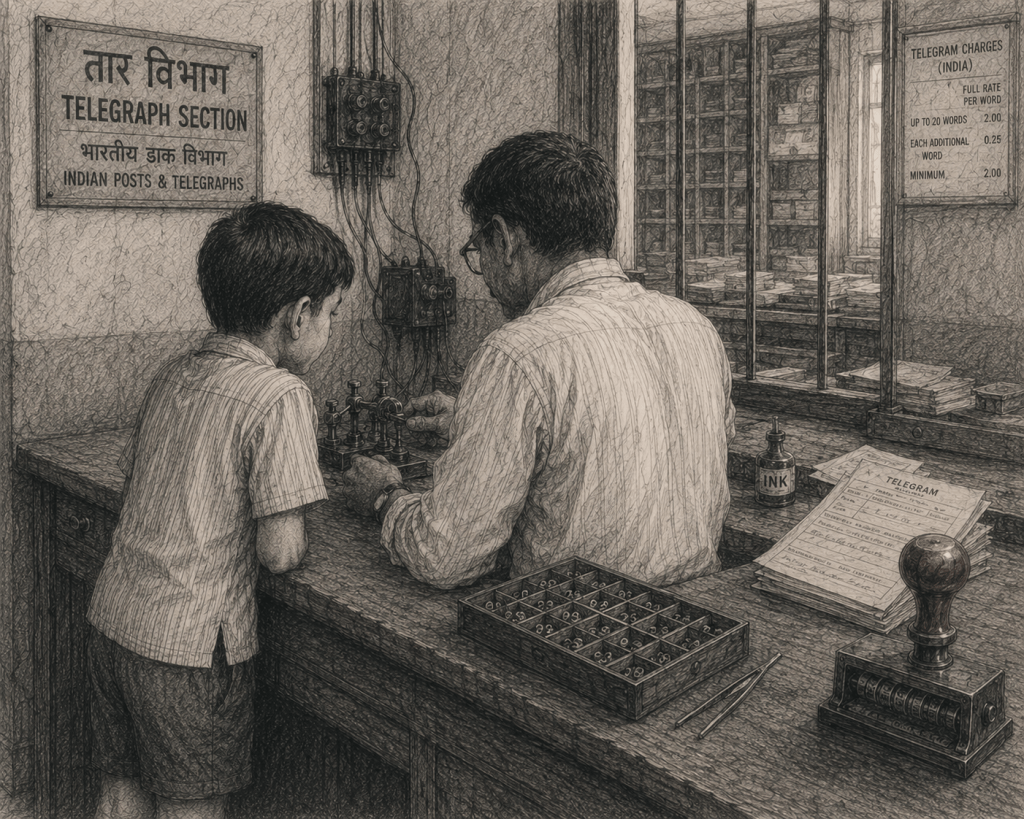
The telegraph machine in the corner was something else entirely. Black, mounted on a heavy base, with a long arm on a central pivot and a round black knob at one end. When the operator pressed that knob, the arm swung -short or long, held or released – and sent something down the wire to a place I could not see. When signals came in, the arm moved on its own, swinging in its short and long arcs and the operator read the movement as it happened, his pencil already forming letters on his pad. The sound it made was unlike anything else in that hall – a clipped mechanical tick, dry and precise, cutting through the general noise the way a specific word cuts through conversation. I used to stand at a careful distance and feel that the machine was having a conversation in a language just beyond my reach. He explained it one afternoon – dots and dashes, every letter a different pattern. S was three short, O was three long and ships sent SOS when they were going under. He tapped it on the table without activating the line. Short-short-short. Long-long-long. Short-short-short. I went home and tapped it on the dining table and on the wall and on my own knee until my mother told me to stop. She said it without looking up from whatever she was reading. I tapped it one more time, very quietly and went to bed.
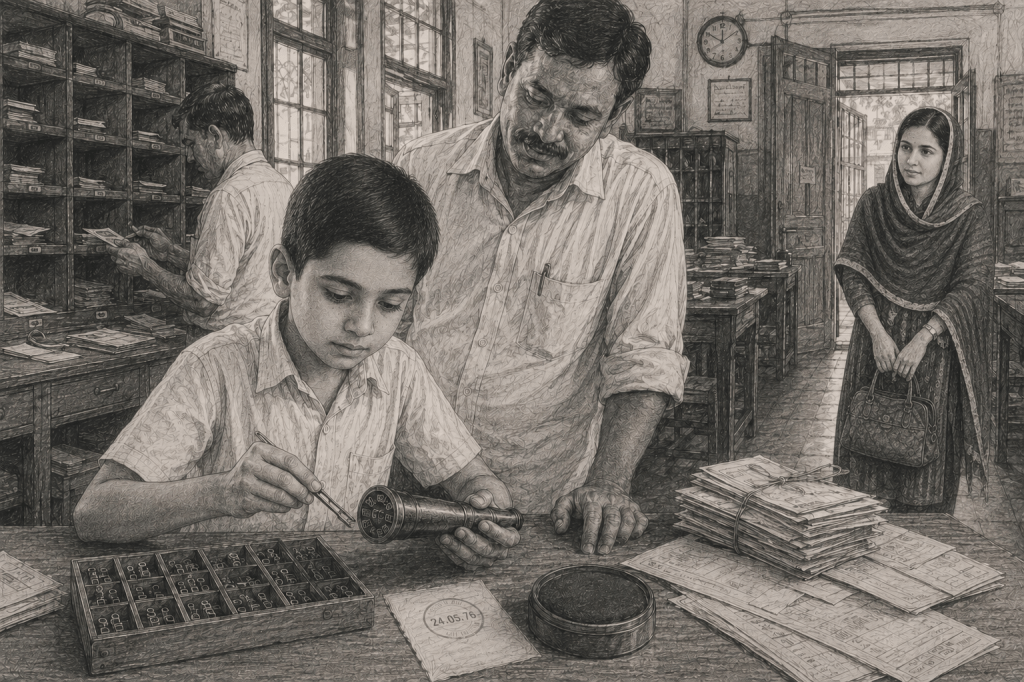
But the thing I loved most, the thing I claimed as mine every single evening, was setting the date stamp. Before closing, someone had to change the next day’s date into the face of the main hand stamp – wide, red-handled, authoritative. The digits were small iron pieces kept in a shallow tray of compartments, each number in its own place, neat as a thought. You picked them out with a thin metal plucker – pressing the prongs around a digit, squeezing, lifting it clean from its compartment -and seated each one into the correct slot on the stamp face. Day. Month. Year. Flush and in order. Then you pressed it on a scrap of paper and read what you had assembled. When the date came out clean and square, I felt something I can only describe as rightness -the particular satisfaction of a small thing done exactly correctly. I asked to do it every evening. Most evenings, someone stepped aside and let the boy have his moment. Once, my mother walked past just as I pressed the stamp down on the test scrap. She paused. She looked at the impression. She said nothing, just continued walking to collect her things. But she had looked. That was everything.
I am smiling as I write all of this. That is the honest truth of it – these are happy memories, lit from the inside, the kind that arrive complete with the smell of strong tea and ink and the sound of that long arm swinging in its arcs. What sits alongside the happiness, quietly, without overwhelming it, is simply the knowledge of what is no longer there.
The telegraph arm is long silent – the service ended, the coded conversations dissolved into faster technologies. The red letterboxes still stand on some corners but hold almost nothing – no one writes letters when a message can arrive in seconds. The inland letter, that pale blue sheet that folded into its own envelope, is gone so completely that younger people look at you blankly if you describe it. And the post offices that were once the hubs of a whole community’s news – humming, purposeful, alive with the particular drama of other people’s lives arriving and departing -have become quieter, smaller places. The counters are there. The forms are there. But the hall does not breathe the way it breathed.
And my mother is not there either, at the back of the hall, glancing up once to say without words that I was allowed and welcome and not to cause trouble.
I wish I could walk in one more time, half past two, bag on my back. Sit in the chair with the loose armrest. Wait for the three o’clock tea. Drift over to the postman and ask if I can sort a few letters. Listen to the arm of the telegraph swing in its short and long arcs. And at the end of the day, pick up the plucker, lift each digit from its little well and set tomorrow’s date – carefully, correctly, flush and square – before handing the stamp back and walking out with my mother into the evening.
Just one more time. That would be enough.