“Papa, redu bana doo.”
She said it, laughing. A little sarcastic. The way she gets when she catches me wandering down memory lane. I don’t remember what I’d been saying before that. Something about the past, maybe. Something about food.
But she wasn’t wrong to say it.
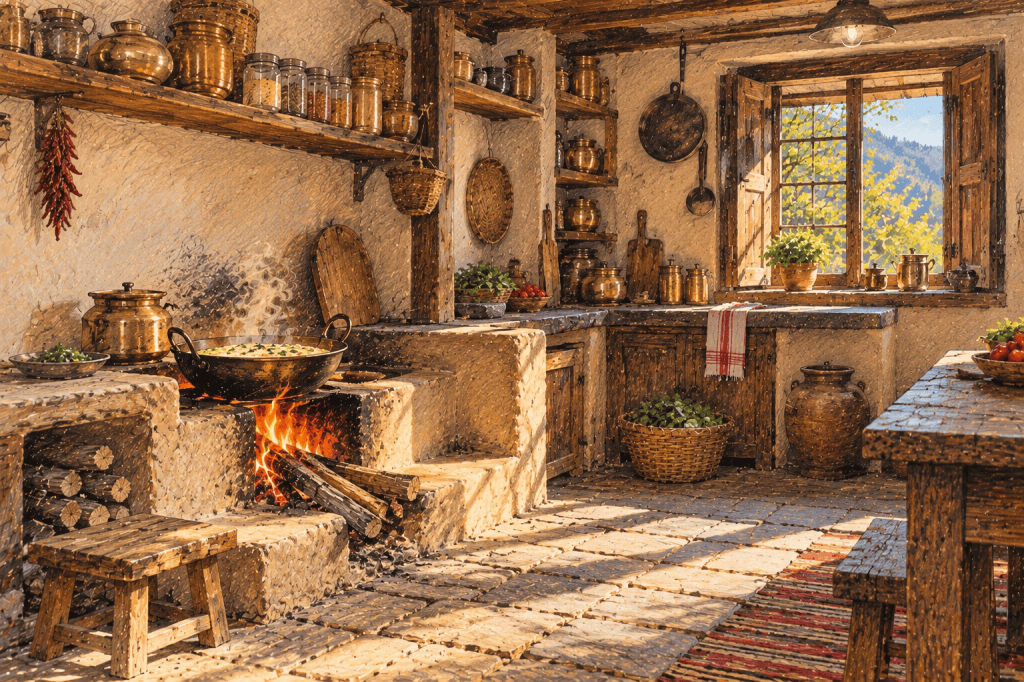
She’s watched it happen enough times to know. When I’m unwell, or just low in some way I don’t explain, there is one thing that sets me right. Not medicine. Not rest. Curd, whisked smooth. A hot tadka poured over it – mustard oil, mustard seeds and cumin crackling, a little garlic, green chilli, a spoon of onion browned soft. Redu, we call it.
She meant it as a joke. Some part of her meant it as a diagnosis.
I didn’t tell her that evening everything that name carries. How could I? Some things you can only hand down. Not explain.
To understand what was really in that bowl, you’d have to go back further than the fever. Back to the garden that grew it. The cow that gave it. The woman who never once thought to buy what she could grow.
· · ─ ·✶· ─ · ·
Amma, my grandmother. That’s what we called her. She raised me for long stretches of my childhood. Straight-backed, even in old age. She carried a stick more out of habit than need. She never went to school, not for a single day and yet she ran a house, a garden and took care of a small boy, with more precision than most people manage with an education. Home was the first school, as far as she was concerned. She never said it like a lesson. She simply lived it.
I did not know, then, that I was watching the whole shape of a life in something as small as a kitchen garden. I know it now.
· · ─ ·✶· ─ · ·
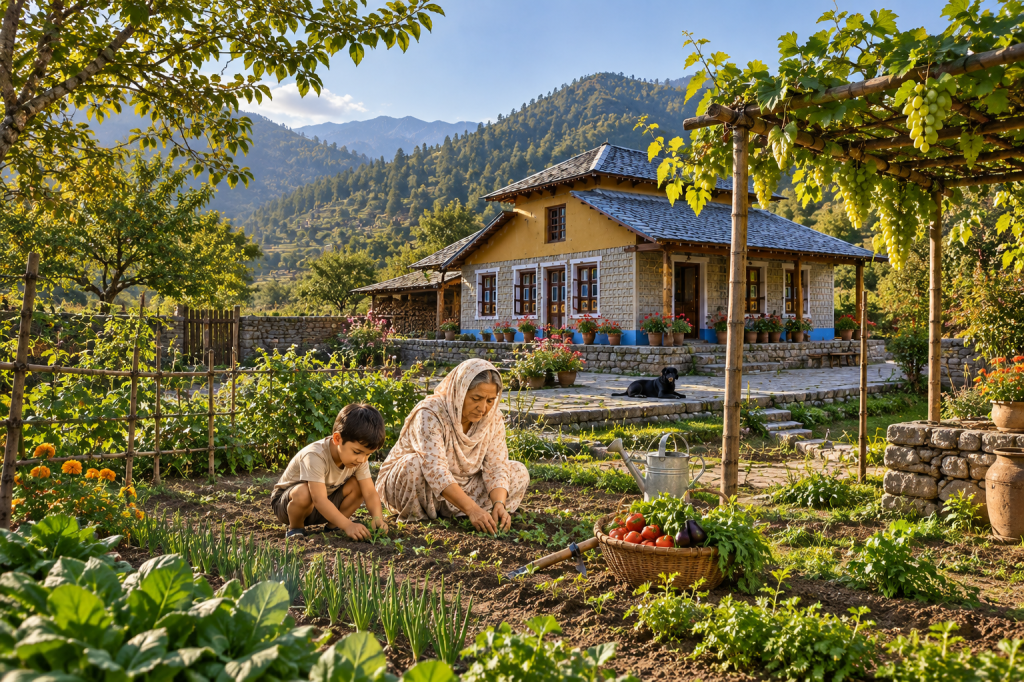
There was one vegetable shop in the village. One, for everyone. Because who was buying? Every house grew its own. So did we.
Chillies and tomatoes went in first. Then brinjal. Then bhindi. Ginger had its own quiet ritual before it ever went into the ground – a few knobs of it kept through summer buried in the sand beneath an earthen pitcher, cool and undisturbed, tucked away in some shaded corner until it was time to plant. Before the monsoon came, the creepers – pumpkin, bitter gourd, bottle gourd – sent climbing wherever a fence would take them. A creeper doesn’t ask for much, Amma said. Give it something to hold and it feeds you all season.
Nothing fancy. Simple food from simple seeds. Grow what wants to grow. Eat what the land gives, without a fight.
Winters had their own ritual. Sarso ka saag – mustard greens, cooked down slow – ready at the onset of cold, cooked regularly, served with a liberal serving of white butter on top of well-smoked makki ki roti. By spring it had turned into full mustard – yellow, taller than me some years – ready to be harvested and taken to the village kolhu, an oil press run by a pair of oxen walking their own slow circles, the seeds crushed patiently until they gave up their oil, thick and pungent, no additives, no expiry label stamped anywhere on the tin it was stored in – just oil, exactly as the seed had meant it to be.
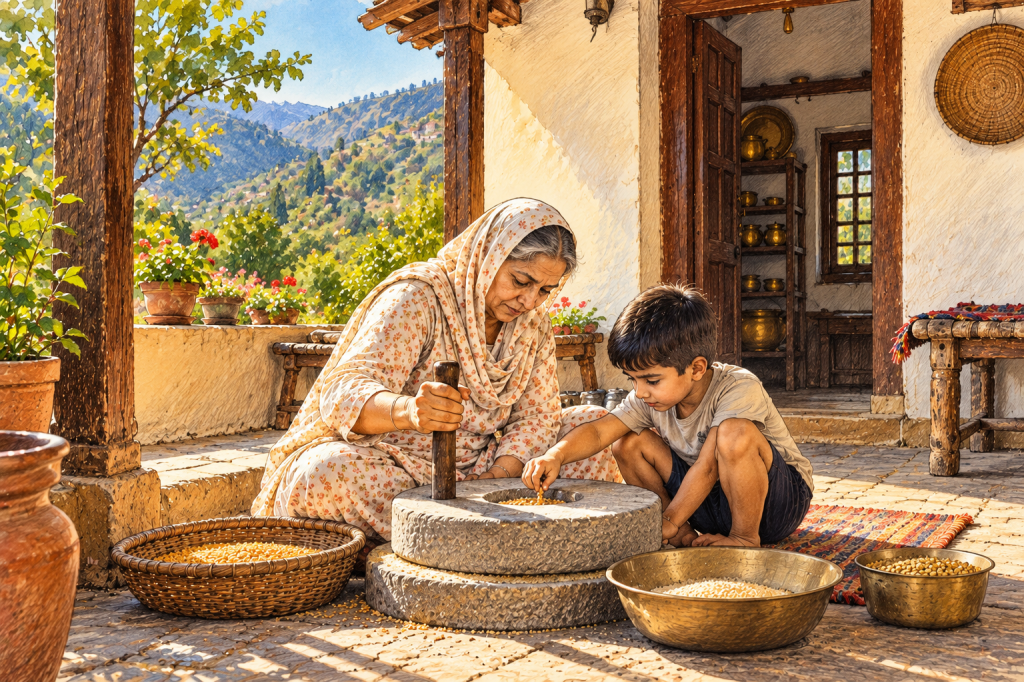
There was a hand chakki too, indoors, for smaller work – two flat stones, one on top of the other, a hole at the centre where the grain went in. Not for fine atta; that stone was set too far apart for that. It only cracked the grain – wheat or maize poured in for daliya, or pulses split down the middle into dal, coming out coarse along the edges as the top stone turned.
There was a kind of folklore around who could grow things and who couldn’t. Certain hands, people said, carried something extra. If so-and-so sowed a seed, it gave a bumper crop. Fruit trees especially.
Did Amma believe she had such hands? She never claimed to. But many a time, she took me along especially, to sow a few seeds with her. Why me? I don’t know. Maybe she thought I was one of those hands too. I never asked. She never said.
I noticed, even as a boy, that whatever she touched in that garden seemed to answer her anyway.
· · ─ ·✶· ─ · ·
We had papaya. Guava. A grapevine that had, over the years, swallowed half the plot – green, heavy, unbothered by how much room it was taking.
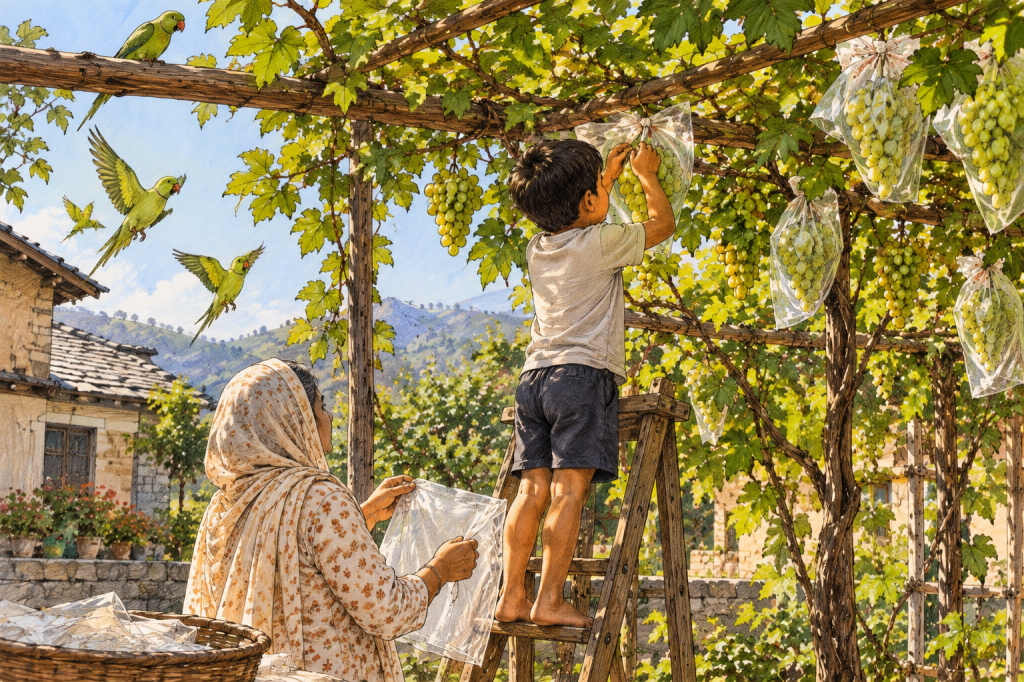
Every summer, as the bunches began to colour, Amma brought out sheets of polythene. Showed me, once, how to wrap each bunch. Tight enough to keep the birds out. Loose enough not to bruise the fruit.
After that one lesson, I was on my own. I became, in my small way, an expert. Climbing. Wrapping. Checking. Defending our grapes from every parrot that circled with intent.
When the bunches finally ripened, they didn’t stay with us. They went out – a share here, a share there – to whoever counted as near and dear. Nobody kept a whole vine’s harvest to themselves.
There was simply that much to spare and that much time to spare it in.
Then the harder fruits – kimb (a large, tangy citron), khatta (a sour citrus, cousin to the kimb), jamun (Java plum), nimbu (lemon). Trees that didn’t need much and gave generously anyway.
Kimb had its own small ritual. The fruit peeled, squeezed for its sharp juice. The pulp cut into pieces, tossed with a rough paste of coriander, ginger, green chillies, salt, a little jaggery, walnuts thrown in for good measure. Sometimes Amma would drop a piece of burning charcoal into a small bowl set into the middle of it. A splash of ghee on the coal. Just to let the smoke curl through before it was eaten. Sharp, sweet, smoky, all at once. Best enjoyed sitting out in the winter sun, with nothing else to do.
And along the edges of our fields – mango trees. Standing like relatives who had been there longer than anyone could remember. Every tree had a history. This one, planted by my father’s uncle. That one, everybody agreed, gave fruit that was nothing special – sour more often than sweet – but nobody ever cut it down. It was still someone’s tree. That mattered more than the taste.
Summers meant raw mangoes before they had any business being ripe. Amma made a chutney out of them with curd and pudina, of course. But there was another use, one I have never seen written down anywhere. She would smoke them right in the hearth, tucked into the embers, almost an afterthought, while cooking something else entirely. Once they had taken on that char, she’d peel them into a steel bowl. Add salt. Add black pepper. That was it. Not quite a chutney. Not quite a dish. Just raw mango, smoky and sharp and very good to eat.
We hardly bought anything from that one shop. Only when a relative arrived unannounced – some uncle stepping off a bus, no warning – did Amma send someone running for what we didn’t already grow. Otherwise, the garden simply told you what was coming. Nothing needed to be planned very far ahead.
We could have bought most of it, I think, if we’d wanted to. It was never about needing to grow it ourselves. It was that growing it, together, was simply the better way to spend a season.
Making vadis was its own small ritual, once or twice a year. Urad dal, soaked overnight, ground down into a thick paste, hand-shaped into small mounds and pressed out one by one. A bedsheet spread across the charpoy, out in the open sun and the whole batch laid out on it to dry – turned every so often over the following days, so nothing went soft or moulded underneath. Once they’d hardened all the way through, they went into a tin, saved for months, for whenever winter thinned out the garden and something more filling was needed in the pot.
· · ─ ·✶· ─ · ·
And then there was the cow.
We always had one. Always. Milk in our house came from nowhere else. I don’t think Amma ever thought it could come from anywhere else. When the doctor once said I needed concentrated milk, for my tender bones, Amma did not send anyone to buy anything. She took me by the hand. Stood me right beside the cow being milked. Had it directed straight into my glass. Warm. No boiling. No in-between. We didn’t know then what we know now. That was simply her answer to a doctor’s instruction. Take the boy to the source.
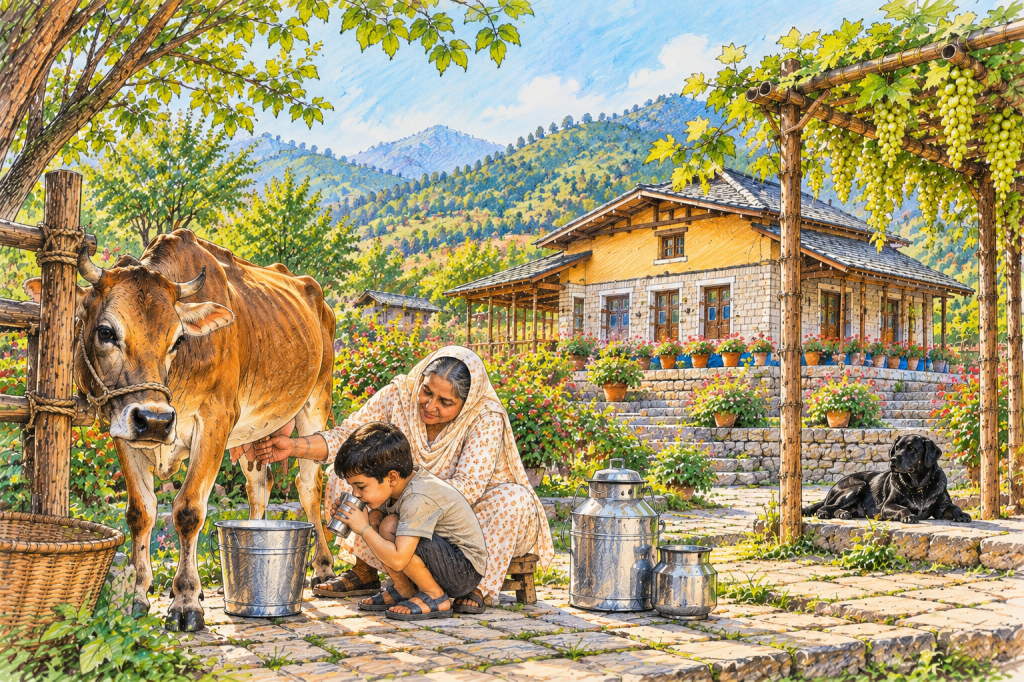
Every night, the fresh milk went onto the rear burner of the hearth, left to boil slow on the dying embers. By morning, a layer of cream sat thick on top. Skimmed off, kept aside. A little each day, until there was enough. That cream went into the madani, a wooden hand-churn, worked round and round until it gave up white butter and buttermilk both. Some of the buttermilk stayed with us.
The butter itself, I remember most. A spoonful of it, white and cold, placed straight onto a hot chapati or makki ki roti. Melting before it even reached the plate’s edge. It went with anything – a vegetable, the saag, a bowl of dal. Whatever was left over at the week’s end was boiled down further, into ghee. Nothing was ever wasted. That ghee went generously onto the chapatis eaten at home, every single day. Curd, too, was simply there. At all three meals. Without fail. Even packed into my tiffin for school.
Whenever a new calf came, there was a different milk altogether. That first, impossibly thick milk a cow gives right after birth. Amma would boil it down slowly, almost like a custard, until it thickened and set on its own. Bolli, we called it. A bowl went to this neighbour. A bowl to that friend. A birth in the shed was, in its own quiet way, everyone’s news to share.
Tipu sat nearby through most of this. Watching, with the patience of a dog who knows something will eventually fall his way. He knew exactly which corner the guavas dropped in. Waited there some afternoons like it was his appointed post. Amma never once shooed him off. He was a living thing. Same as any of us. That, to her mind, was reason enough.
· · ─ ·✶· ─ · ·
Sugarcane came later in the season. The whole village shifted its rhythm for it. Stalks carried on shoulders to the belna – the one wooden press in the village, turned by bullocks walking their slow, patient circles. Everyone’s cane eventually passed through that same creaking wheel. Children stood with steel tumblers for the first frothy pour. Not even a passerby who had only stopped to watch.
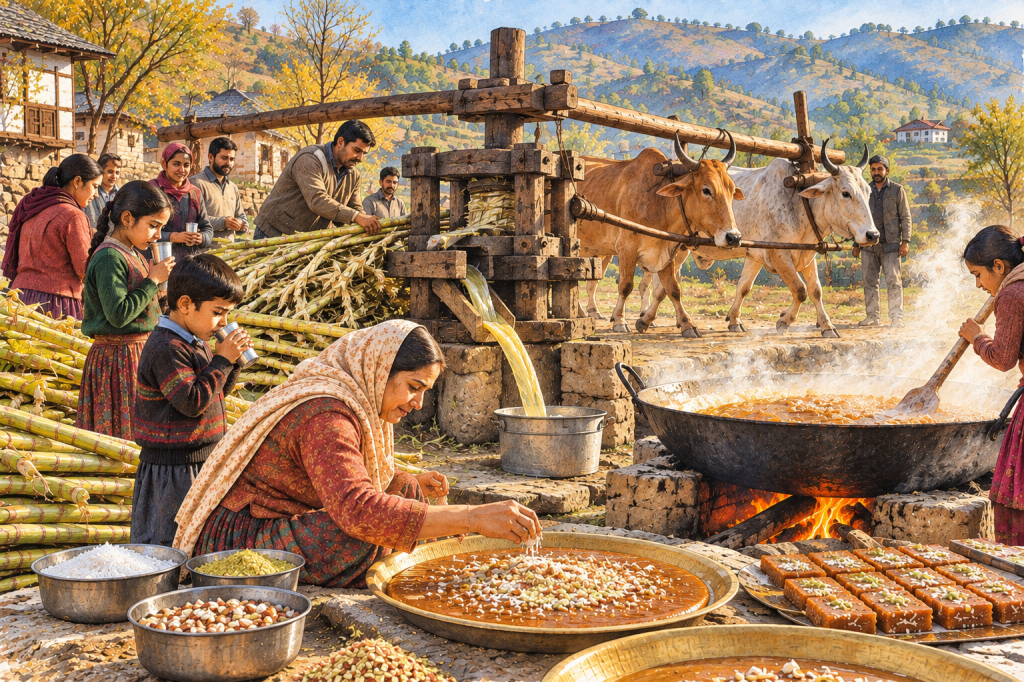
Some of that juice went into gur and shakkar, boiled down slowly in a wide iron pan, right there in the open field, until the whole area smelled of it. And some, while still molten, was poured hot onto brass plates. Sprinkled with coconut, saunf, dry fruits. Left to set into putli – a jaggery sweet, cut into pieces, gifted around. Long before anyone in the village had heard of a chocolate box.
The kheer that followed – cane juice and rice, boiled down patiently over a slow fire – went out in bowls to relatives and neighbours before we had even properly sat down to our own share.
Weddings brought their own food. Always cooked in bulk by the one man the whole village trusted for such occasions. Babru – dough stuffed with a sweet spiced filling, folded shut, deep-fried till it puffed and browned – much like gune, jaggery worked into a stiff wheat dough, rolled thin, cut into strips, fried crisp. Bhaturu – softer, a fermented wheat dough left to rise overnight, then shaped and fried till it turned light and faintly tangy.
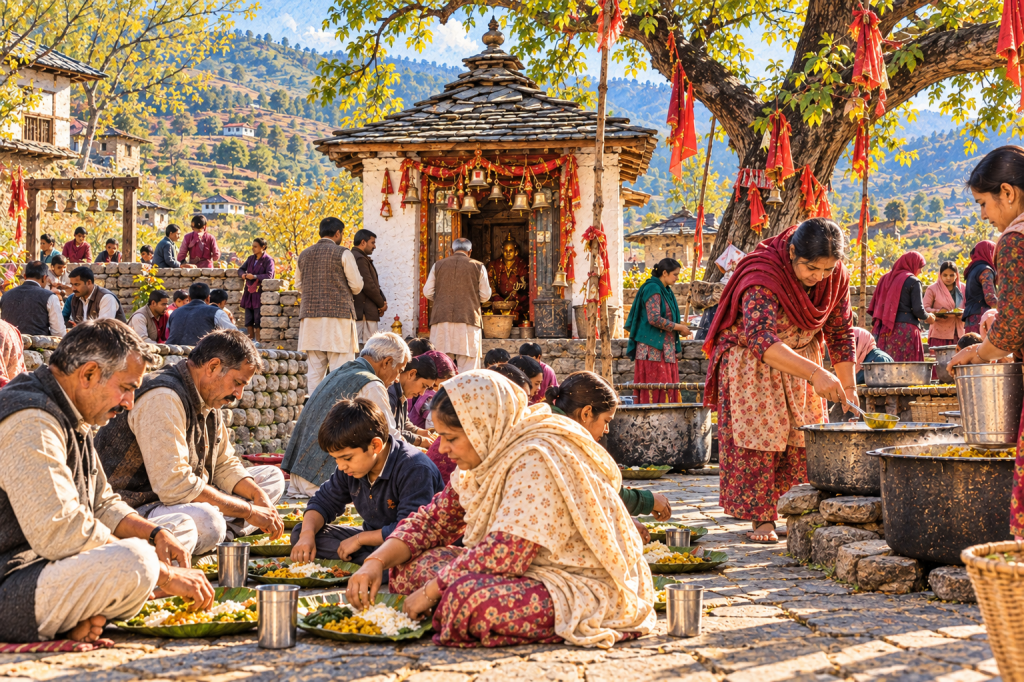
And then the feasts at the local deity’s place. Small, half-forgotten shrines. More animistic, even to me as a boy, than anything you would call organised religion. Once after harvest and again in summer, the whole clan gathered there for a meal, paid for by whatever each family’s fields had given that season. Less an obligation than a reason to sit together. I still try, even now, to make it back for those, whenever I can.
· · ─ ·✶· ─ · ·
All of this – the garden, the cow, the belna, the wedding sweets, the deity’s feast – was simply what a year looked like, back then. Redu was just one small piece of it. The part that happened to show up whenever someone fell ill.
Nobody in that house was short of time either – not really. There was always enough of it to prepare something slowly, to sit through an evening, to send a bowl next door and stay a while at the door talking. That, more than the land or the garden, was the real wealth of it.
I have a kitchen garden even today. One I tend to only occasionally now. But the colours, the freshness of what comes out of it, still remind me of everything that came before. Some mornings – the smell of mustard cooking somewhere, a raw mango sitting on a cart – and I am back there entirely. Standing beside a cow, glass in hand. Tipu waiting for a guava to fall. Amma, unhurried, already thinking about what needs to go into the ground next.
But a garden only goes so far these days. For everything it can’t give me, there’s still the mall. Shelves of things with foreign names. Avocados wrapped in plastic. Milk in cartons stamped with tidy expiry dates. Butter that has never once seen a hearth, a madani, or a hand that turned it round and round for someone else’s sake. All of it clean. All of it convenient. All of it, without exception, entirely forgettable.
Why forgettable? Because that is the part no shelf will ever hold. Not the butter. Not the curd. Not even the redu, if I am honest, though I will keep making it badly for the rest of my life.
It was never really about the food. It was about a woman who fed an entire village on instinct and habit. Who gave away more than she ever kept. Who is gone now – and yet still arrives, uninvited, every single time something warm is placed in front of me.
If you had a childhood like this – one vegetable shop, one grapevine, one belna for the whole village, one woman who fed you before she ever fed herself – you already know. There is no aisle for what we lost. No label for it. It doesn’t come shrink-wrapped. It never once needed to.
· · ─ ·✶· ─ · ·
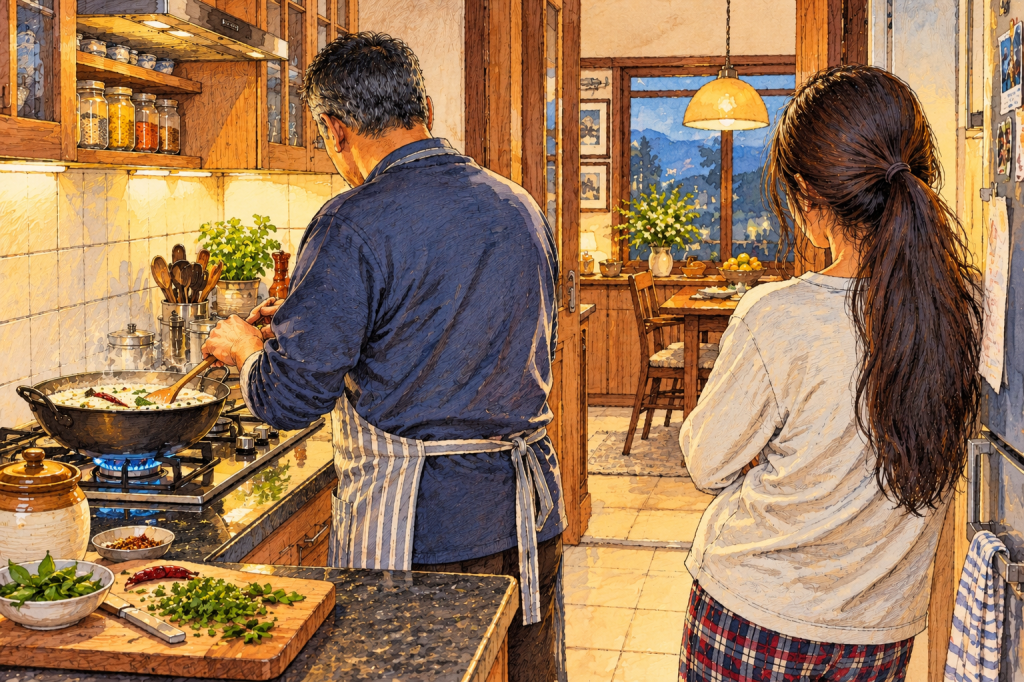
That evening, I made redu. Badly, of course. I do not temper curd the way she did. I never will.
I put the bowl down anyway. My daughter watched from across the kitchen – not really watching the redu, I think, but watching me. That quiet look of someone who already knew exactly what would happen next: the too-sharp smell, the curd splitting a little at the edges, the small failure I would pretend not to notice. She did not need to say anything. She never does, with things like this.
I don’t know when she started noticing such things. Somewhere between being a child underfoot in this same kitchen and being someone who now stands in doorways with her arms folded, seeing more than we meant to show. I certainly never sat her down and explained any of it – not the garden, not the cow, not why a woman who has been gone for years still shows up whenever a pot is set to boil. Amma was simply present for enough of it, often enough, without either of us calling it a lesson.
That is my daughter’s gift to me, without even trying to give it. She has watched closely enough, all these years, to know what home tastes like. To know, without being told, exactly when I need it most – this evening, for instance, when the day had gone long and something in me needed reducing down to a smell rather than a sentence. She said nothing about the curd not being right. She never does. She simply let me have the making of it, badly, in peace.
Some things get handed down that way. Not explained. Just recognised. One generation after another. In a bowl. In a smell. In a hand that reaches out before it even knows why – hers reaching for the spoon before I’ve asked for it, the way mine once reached for Amma’s, in a kitchen much like this one, a lifetime ago.
A bowl of curd. A memory of fever. A woman who is gone now.
And a daughter who somehow, still, knows exactly what to say – even when, like her great-grandmother before her, she says nothing at all.

