“The past clings to us. Sometimes it is a burden, sometimes a treasure” — Ruskin Bond, Rain in the Mountains
As I walked through the fields of my village, I paused. Something was missing. Where were the tall stalks of sugarcane? In my childhood, every household had them. Each family kept a small field sown with cane. The crop stood like proud green sentinels, promising sweetness at the end of winter. But today, not a single field remained.
Why does this absence hurt so much? Perhaps because sugarcane was never just a crop. It was a season, a celebration, almost a festival. I remember that the harvest always came in March, after the school exams. How we waited for it! The men cut the cane, carried it on their heads to the belna—the great wooden press powered by bullocks walking in circles. There was only one belna in the entire village, but that one machine was enough to keep the whole community alive with activity.
Do you know what the belna meant to us? It was not just about juice. It was about gathering. It was about sharing. As the rollers crushed the cane and juice poured out, children stood with steel tumblers, waiting for that first frothy sip. Passersby were offered a glass—no one went thirsty. The village breathed together around the belna.
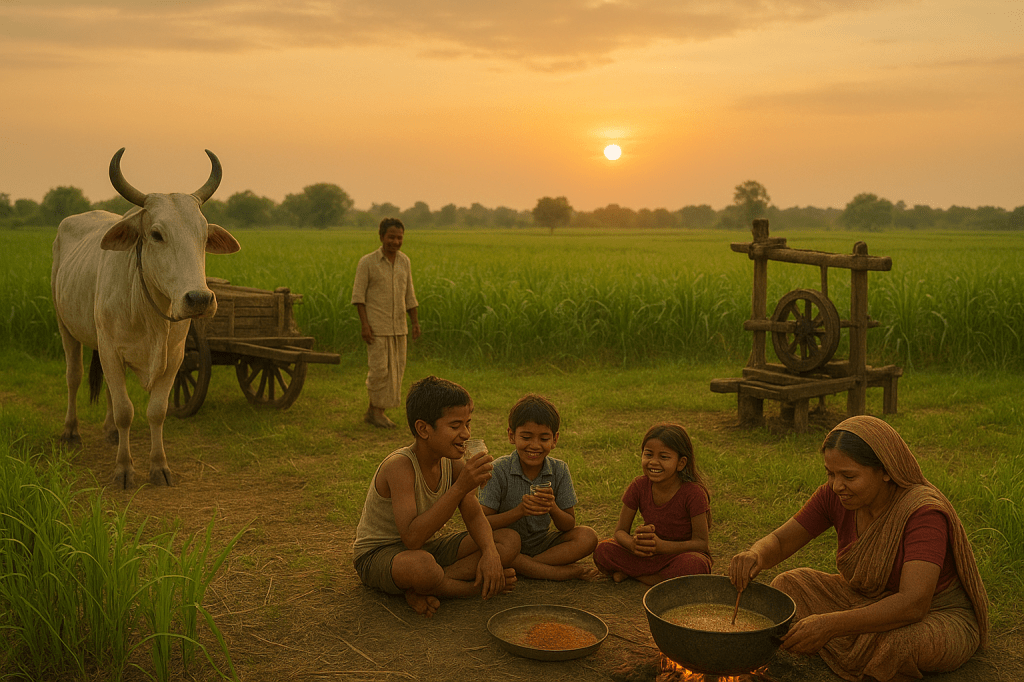
And what about the fragrance? Do you remember it? The boiling juice in a wide iron pan, slowly thickening into golden jaggery. That smell carried by the evening wind—sweet, earthy, irresistible. Families booked their day to prepare gur(jaggery) and shakkar (coarse, brown, sweet sugar), stocking up for the year, gifting to others.
There was also creativity. Who can forget the putli(jaggery dry-fruit sweet)? Fresh molten jaggery, poured hot like lava into brass plates, sprinkled with coconut, saunf, dry fruits. A local delicacy, preserved, cut and gifted with pride. Tell me— What could be more meaningful than such a gift? Before Amazon, before chocolates, before plastic-wrapped sweets—there was this—a gift made not by money, but by love.
And then came the kheer. Rice simmered in fresh sugarcane juice. Its taste? Beyond words. Even now, if I close my eyes, I can almost feel it on my tongue.
But today, I saw none of this. No cane. No belna.
No fragrance in the air. And so, I turned to my father. “Why don’t people grow sugarcane anymore?”, I asked. His face fell. His voice was heavy. “It takes too much effort. People have money now. They can buy gifts, buy sweets, buy whatever they want. Who has the time for the hard work of tending cane, extracting juice and making jaggery? And when no one comes to the belna anymore—why should it survive?”
I had no answer.
Tell me, what have we really lost? Was it just a crop? Just a machine? No—it was our togetherness. Our sharing. Our childhood laughter. Our very rhythm of life. The belna did not just press cane; it pressed sweetness out of the soil and poured it into our lives.
And now? The belna stands silent. The bullocks are gone. The iron containers cold. As I walked away into the setting sun, the fields stretched empty before me. No fragrance of jaggery. No children waiting with tumblers. No laughter drifting in the air. Only silence. And I wondered—has the sweetness truly gone… or does it still live, hidden, waiting, in our memories?
 Musings of a Wanderer